
Monday, February 27, 2012


Thursday, February 16, 2012

Monday, February 13, 2012


Sunday, February 5, 2012

Saturday, February 4, 2012

Friday, February 3, 2012
64-year-old tub of lard found in Germany -- still edible
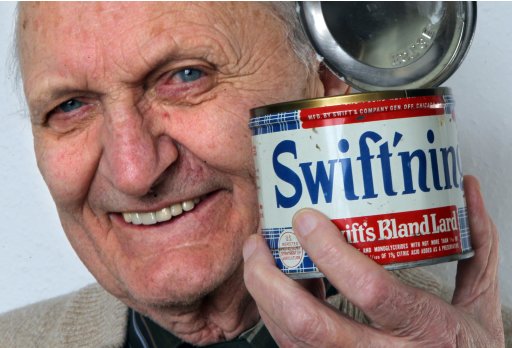
(AFP) A German pensioner who had kept a tub of lard in his cupboard for 64 years, took it to authorities who pronounced it very much fit for consumption -- if a little tasteless.
Feldmeier said he had been given the tub together with two tins of noodles and some milk.
"I just didn't want to throw it away," he explained.
Finally, after 64 years, he took it to food safety agents and was astonished at their appraisal.
"There is of course a slight lack of smell and taste," sniffed Frerk Feldhusen, from the office of agriculture, food safety and fisheries in the eastern state of Mecklenburg-Western Pomerania.
Moreover, the lard was "of gritty consistency, difficult to dissolve and looked a bit old," the officials added.
However, "all in all, given its level of freshness and its material composition, the product is assessed as satisfactory," Feldhusen said, adding it would stand up to today's definition of being fit for the dinner table.
Wednesday, February 1, 2012
The lost pages of the Summa
Shared on a Yahoo group - Part of the Benedictine College philosophy department's celebration of St. Thomas' feastday included a contest: write your own question in the style of St. Thomas' Summa. The winning submission, written by Joseph R.
Whether a zombie possesses scientific knowledge?
Objection 1: It seems that a zombie cannot possess scientific knowledge. For the brain is required in order for the imagination to produce phantasms, and, as the Philosopher says in the De Anima, “the soul understands nothing without a phantasm.” Now it is known of zombies that they desire the human brain. But no thing desires what it already possesses, as was said above. Therefore zombies do not possess a brain and so cannot obtain the phantasms necessary for knowledge.
Objection 2: What does not have being cannot know. Now it is known that zombies can exist only during the “zombie apocalypse”, but nowhere in the Book of the Apocalypse does the apostle John mention zombies. Therefore zombies do not exist. Therefore they cannot know.
On the Contrary:
Although he only speaks one word, the word “brains”, it is known that a zombie is able to speak. But according to the Philosopher in De Interpretatione, “spoken words are the symbols of mental experience.” Therefore zombies have mental experience. In order to have mental experience one must have an intellect and be able to know. Therefore zombies must have scientific knowledge.
Response:
The term “zombie” is understood in two ways.
First, we call a man who is not acting in full rationality on account of drunkenness, sleeplessness, or laziness a zombie. Those who lack the necessary means to make themselves alert upon waking up are also called zombies. It is in this way that the Philosopher speaks of the Pythagoreans and those who proposed Ideas. While those spoken of as zombies in this manner may not act as if they possess knowledge, we must still say that they have both the capacity to know and the habit of scientific knowledge. For we would not say that a drunken man does not know, but only that he acts as if he does not know. In the same way, we would not say that the zombie, whether he is a lazy student or an exhausted man, does not know, but only that he does not act as if he does.
Secondly, we speak of a zombie as the nonliving corpse of a man made to move as if it were living. It is the opinion of some that a zombie of this kind is a dead body given some of the perfections of an animal soul while still remaining a dead body, but this is not possible. For the matter of a dead body, being without life, inasmuch as it is dead, has none of the perfections of a living being and cannot obtain these perfections unless it is in some way disposed to the reception of an animal soul. Therefore a zombie of this kind must be made to move as if it were alive by some exterior living agent, as the puppet though not alive, is made to move as if it were alive by the hand, which is living. But since there is no sign of an exterior material agent moving the corpse, as there is in the case of the puppet, we must say that the exterior agent moving the corpse is immaterial. But if this agent is immaterial, it must be capable of knowledge, as we said above. Therefore even this kind of zombie is capable of knowledge, or at least the agent moving the corpse.
Ad 1: A thing can be desired in two ways. First, according to its proper function. Second, because of some accident. It is in the second way that a zombie desires the human brain. For a zombie desires the brain not on account of its usefulness in producing phantasms, but according to an accidental aspect, namely, insofar as it is food for the zombie.
Ad 2: While there is no mention of a “zombie apocalypse” in the Book of Revelation, it is manifest that zombies can exist at times other than the last days. That zombies exist even at this time is clear from the writings of Siger of Brabant on the eternity of the world and the teachings of David of Dinant on the Divine Essence.
Thursday, January 19, 2012
Walken on the Wild Things
Read with such insight.
"...bear strung up, I assume murdered. Maybe suicide, I don't know."
"...bear strung up, I assume murdered. Maybe suicide, I don't know."
Wednesday, January 4, 2012
Pepsi Says Mountain Dew Can Dissolve Mouse Carcasses

Jasper Nance via Flickr
(The Atlantic Wire) Pepsi Co., facing a lawsuit from a man who claims to have found a mouse in his Mountain Dew can, has an especially creative, if disgusting, defense: their soda would have dissolved a dead mouse before the man could have found it. An Illinois man sued Pepsi in 2009 after he claims he "spat out the soda to reveal a dead mouse," the Madison County Record reports. He claims he sent the mouse to Pepsi, which then "destroyed" the remains after he allowed them to test it, according to his complaint. Most shudder-worthy, however, is that Pepsi's lawyers also found experts to testify, based on the state of the remains sent to them, that "the mouse would have dissolved in the soda had it been in the can from the time of its bottling until the day the plaintiff drank it," according to the Record. (It would have become a "jelly-like substance," according to Pepsi, adds LegalNewsline.) This seems like a winning-the-battle-while-surrendering-the-war kind of strategy that hinges on the argument that Pepsi's product is essentially a can of bright green/yellow battery acid. The lawyers still appear to be lawyering behind the scenes but we cannot wait for this to come to trial (though we think a trial is about as likely as the chances of us "Doing the Dew" ever again).
Tuesday, January 3, 2012

Sunday, January 1, 2012
Facing Cocoa Shortage, Swiss Chocolate Makers Aim To Boost African Production
Famous for its chocolate production, Switzerland relies on Ghana for half its supply of cocoa beans, even as the West African nation now focuses on other export products. A new public-private Swiss partnership aims to inject new life into cocoa bean farming.

By Kaspar Meuli
LE TEMPS/Worldcrunch
SUHUM – It was one year ago that Ghana’s president John Atta Mills announced the country's first-ever launch of an oil platform. The December 15, 2010 pomp-filled ceremony, in front of television cameras, marked Ghana's arrival among the ranks of oil producers. Experts say that was also a bad day for the country’s cacao producers, as the raw material -- a traditional Ghanaian export -- would no longer get the attention or investment necessary to be sustainable.
The situation was particularly disquieting to Swiss chocolate makers as Ghana is their most important supplier. More than half of the cacao beans transformed into chocolate in Switzerland come from the Western African nation. “Cacao consumption goes up globally by 2% to 3% annually, and that rhythm has been sustained even during crisis periods,” says Kamillo Kitzmantel, General Manager of Lindt & Sprüngli Suisse. “Supply can’t meet demand, as new suppliers like Vietnam or the Philippines have yet to show that they can deliver the required quality levels.”
The Ghana Cocoa Board, a state-run organization that promotes cacao bean production, says that local trees have become too old, threatening to make harvests even more meager. If the 2011 harvest set a record it was only because of exceptionally favorable weather. And beyond the neglect of tree renewal initiatives, there is also a looming shortage of farmers. The average age of cacao farmers is around 55 years old – in a country where life expectancy is 58.
The face of such threats to its top supplier, Switzerland has stepped in with a private pilot project that is receiving Swiss government support. “We show farmers how they can earn money by growing cacao,” Yayra Glover explains. “The first step is to get the farmers to feel proud of their production. In Switzerland, there are buyers ready to pay above market price if cacao is produced without child labor or the use of chemical products.”
The Ghanaian entrepreneur lived in Switzerland for more than 20 years, then decided to return to Ghana to take up sustainable cacao farming. He is now located in Suhum, in the eastern part of the country, working with 2,500 small farmers who grow cacao organically.
Distribution chains and chocolate
Glover’s initiative was possible thanks to his close partnership with Pakka, a Zurich-based company specialized in the development of fair trade for organic produce from southern countries. Pakka also sells products like nuts, dried fruit – and cacao.
“Producers in southern countries can’t get into the European market on their own,” says Balz Strasser, Pakka’s general manager. “We support them by building the necessary networks and distribution chains.”
Part of the organic cacao from Ghana is thus delivered to Max Felchlin AG, a company in the canton (district) of Schwyz that provides chocolate makers and restaurants with semi-finished chocolate products.
A little more than four years on, the project has cost 1.3 million Swiss francs ($1.38 million). Nearly half (47%) came from the Swiss State Secretariat for Economic Affairs (SECO). The private sector (notably Pakka and Max Felchlin AG) and non-governmental organizations in Ghana came up with the rest.
The example of Yayra Glover may inspire others. The Economic Cooperation and Development division of SECO foresees geographic expansion into the Volta region in the southeast. This would also be a way of stemming rural exodus. Several of Glover’s young employees come from Accra, where they graduated from university. Today, they are dedicated to farming cacao. “I’ve bought some land of my own, and have put in some baby plants,” says Samuel Quaque, a manager at Glover’s company. “I imagine my future on a plantation, not in a city.”
Read the original article in French
Photo – Benketaro
Monkey stolen from California zoo found safe
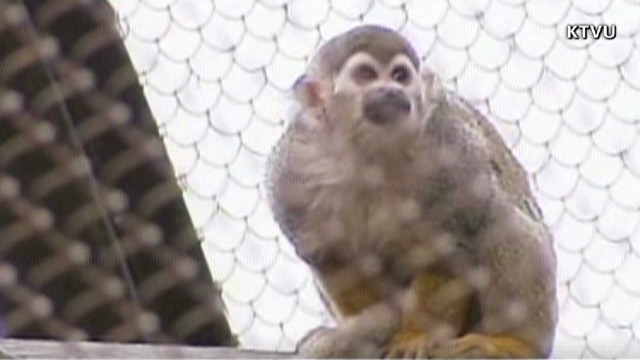
(CNN) -- Banana-Sam, a much-loved squirrel-monkey stolen from his enclosure at the San Francisco Zoo, has been safely returned, officials said.
The monkey was found Saturday night -- a day after he disappeared from the zoo -- at a park by a passer-by who spotted the primate in the bushes, the San Francisco Police Department said in a statement.
The passer-by coaxed the monkey from the bushes into his backpack, and then called the authorities, according to the statement.
Police officers brought the monkey to the zoo, where officials determined it was the missing primate.
"Although hungry, trembling and thirsty, Banana-Sam is currently safe back," the zoo said in a statement.
Zoo workers discovered the theft Friday morning, when they found a back perimeter gate had been breached and two holes cut in the mesh fence of the squirrel monkey exhibit.
The male monkey, known as Banana-Sam to his keepers, is age 17, over 12 inches tall and weighs about 2 lbs. Corrine MacDonald, the curator of primates and carnivores, told CNN affiliate KGO earlier Saturday that squirrel monkeys can live into their 20s, saying his relatively advanced age could put him at more risk.
Banana Sam' keepers warned the public that while he looks very cute, he is not a pet -- and can deliver a nasty nip. The curator said such monkeys carry diseases and can cause serious infections if they bite a human.
The monkey needs a specialized diet to stay healthy, the zoo says.
What motivated the thieves to swipe the monkey is not clear. Common squirrel monkeys are not endangered, and they can be found at pet trade markets -- with such sales illegal in California, the zoo says -- or medical research institutions.
MacDonald said the zoo's other squirrel monkeys were visibly shaken by Banana-Sam's apparent capture. She said the decision was made to pull them off the exhibit due to concerns about the integrity of the exhibit and that a "copy-cat" could try to take other monkeys.
It was not immediately known when the zoo planned to reopen the exhibit.
An unknown person was quick to set up a fake Twitter account in Banana-Sam's name, following in the path of a cobra that escaped at New York's Bronx Zoo in March. The snake's mock Twitter account, with humorous tweets on its supposed whereabouts in New York City, swiftly attracted a large online following.
Under the handle @SF_BananaSam, the "monkey" is now tweeting his way round San Francisco.
"Went to monkey bars in Golden Gate Park playground, left disappointed. #nobananadaiquiri" one post reads.
Another says: "I'm a funny-looking vegan who ran away from home and who people follow on Twitter. IN other words, A NORMAL SAN FRANCISCAN."
Friday, December 30, 2011
Monkey Stolen From San Francisco Zoo
By Mike Anderson
 Someone broke into an exhibit and stole a monkey from the San Francisco Zoo, the zoo discovered Friday morning.
The one-foot-tall squirrel monkey's name is "Banana-Sam." He is 17 years old and weighs about two pounds
The vandals apparently cut through a zoo gate overnight. Then they got onto the roof of the primate exhibits. The zoo found two holes cut through the mesh net where Banana-Sam was stolen.
Although he appears cute and cuddly, Banana-Sam has very sharp teeth and will not hesitate to bite if provoked, according to Zoo staff. His bites can easily cause infections. The monkey also eats very particular food...
Someone broke into an exhibit and stole a monkey from the San Francisco Zoo, the zoo discovered Friday morning.The one-foot-tall squirrel monkey's name is "Banana-Sam." He is 17 years old and weighs about two pounds
The vandals apparently cut through a zoo gate overnight. Then they got onto the roof of the primate exhibits. The zoo found two holes cut through the mesh net where Banana-Sam was stolen.
Although he appears cute and cuddly, Banana-Sam has very sharp teeth and will not hesitate to bite if provoked, according to Zoo staff. His bites can easily cause infections. The monkey also eats very particular food...
Tuesday, December 20, 2011
Penn sees red in LAX tirade
(New York Post) Sean Penn and Cuban actress Maria Conchita Alonso were once Hollywood co-stars — but they had an angry bust-up at LAX, with Alonso branding Penn a “communist [bleep]hole” after he called her a “pig” in front of a stunned crowd.
It started when Alonso picked up her mother from a Miami flight and spotted Penn in an American Airlines lost luggage area Sunday.
Alonso, born in Cuba and raised in Venezuela, says her “heart stopped” when she saw the actor, to whom she’d written an open letter last year to say she was “appalled” by his public support of Hugo Chavez.

She told Page Six: “I was very calm. I said, ‘I would like to talk to you.’ He said, ‘I have nothing to say to you . . . You have been saying a lot of things about me in the press.’ I said, ‘How can you defend Chavez?’ ”
The argument escalated from there. Alonso relates: “I said, ‘You are a communist, Sean Penn.’ He said, ‘You are a pig!’ So I said, ‘And you are a communist [bleep]hole! Is it great to live the way you do as a communist?’
“I went back to my mother, and he started yelling at us,” Alonso told us. “I yelled back, ‘Communist [bleep]hole!’ Nearly 60 people were watching, shocked. My mother wanted to clap, but she couldn’t because she was in a wheelchair and she had a small dog in her lap...”
It started when Alonso picked up her mother from a Miami flight and spotted Penn in an American Airlines lost luggage area Sunday.
Alonso, born in Cuba and raised in Venezuela, says her “heart stopped” when she saw the actor, to whom she’d written an open letter last year to say she was “appalled” by his public support of Hugo Chavez.
UPI
Sean Penn
The argument escalated from there. Alonso relates: “I said, ‘You are a communist, Sean Penn.’ He said, ‘You are a pig!’ So I said, ‘And you are a communist [bleep]hole! Is it great to live the way you do as a communist?’
“I went back to my mother, and he started yelling at us,” Alonso told us. “I yelled back, ‘Communist [bleep]hole!’ Nearly 60 people were watching, shocked. My mother wanted to clap, but she couldn’t because she was in a wheelchair and she had a small dog in her lap...”
Sunday, December 18, 2011

Woman chooses pet crocodile over husband
An Australian woman, Vicki Lowing, says she divorced her husband after he asked her to give up her pet crocodile, Johnie, which she says is ‘like a child' to her.


(Confucious Institute Online) WHEN Johnie the croc wants walkies, her owner makes it snappy.
Johnie - a female - rules the roost at the Lowing home.
Her favourite time of the day is meal time, the Herald Sun reports.
"She's just like a cat or dog in that she knows when the fridge door opens there is a good chance of a snack, so she shuffles in for a feed," Vicki Lowing said.
Chicken wings are her favourite, along with whiting and red meat.
Ms Lowing said her son Andrew, 15, and Johnie, 13, experienced sibling rivalry.
"Sometimes Andrew goes to have a shower after school and Johnie's already in there and not keen to share the space," she said.
Andrew turns on the cold water tap and watches the cranky croc beat it....

Saturday, December 17, 2011
Boy disciplined after waving gun-shaped pizza slice
Reported By Andy Cordan, Reporter
(WKRN) For the rest of the semester, a Rutherford County elementary student has to eat lunch at the "silent table" for allegedly waving around a slice of pizza some say resembled a gun.
Nicholas Taylor attends David Youree Elementary School in Smyrna, about 30 miles southeast of Nashville.
School leaders say the 10-year-old threatened other students at his lunch table with a piece of pizza with bites out of it so it looked like a gun and when asked about it was initially not truthful.
Nicholas' mother LeAnn calls her son's punishment "absolutely ridiculous" saying he was just playing around and never said anything derogatory or anything about shooting anyone.
"The kid across the table from him said it looked like a gun so he picked it up and started shooting it in the air," she told Nashville's News 2 Investigates.
Taylor said she learned of the incident when the school sent her a note saying her son was threatening other students.
James Evans, spokesperson for the Rutherford County School District, said the boy isn't being punished because he had a piece of pizza shaped like a gun.
He's being punished because "some students reported he was making some threatening hand gestures, that he was shooting other kids at the table and they reported it to a teacher," according to Evans.
He continued, "The student didn't tell him the truth about it so he got silent lunch for six days."
Evans called the punishment minor but said the message is clear.
"I realize some might say we are going overboard but the principal is just trying to use an abundance of caution and send the message that we don't play about guns and it's not something we joke around about," he said.
To that, Taylor said her son knows he shouldn't play with guns.
"We don't have a gun in the house," she said. "He plays with light sabers. He's a big Star Wars fan."
In addition to lunch at the silent table, Nicholas has spent time with the school resource officer learning about gun safety.
Taylor said the school system has made it clear that if her son eats his pizza into the shape of a gun again and there is a similar occurrence, he will be suspended.
Unexplained shower of apples falls from sky over town
By Eric Pfeiffer
 (Yahoo News) More than 100 apples mysteriously rained down upon a small British town on Monday night. The still-unexplained apple shower left 20 yards of city streets and car windshields covered in the cascading fruit just after the daily rush hour.
The news immediately brought up comparisons to biblical tales of raining frogs and whether such reported freaks of nature actually occurred. In this instance, no one has officially confirmed when, how or if the apple storm truly took place as described.
However, Jim Dale, senior meteorologist from the British Weather Services, told the London Telegraph: "The weather we have at the moment is very volatile and we probably have more to come. Essentially these events are caused when a vortex of air, kind of like a mini tornado, lifts things off the ground rising up into the atmosphere until the air around it causes them to fall to earth again."
Dr Lisa Jardine-Wright, a physicist at the Cavendish Laboratory, based at Cambridge University, told the BBC, "Cars and houses have been swept up by tornadoes, so apples are well within the realms of possibility. A tornado which has swept through an orchard will be strong enough to 'suck up' small objects like a vacuum [cleaner]. These small objects would then be deposited back to earth as 'rain' when the whirlwind loses its energy."
Nevertheless, witnesses report that the weather in Coundon in Coventry was reported to be stable and calm at the time of the alleged apple shower. Coventry residents have offered several competing explanations for the event, including a passing plane, roving teenage pranksters--and, yes, witches.
But regardless of the ultimate explanation, the apple storm is no stranger other confirmed, highly unusual forms of precipitation. The BBC offers a roster of pertinent examples:
(Yahoo News) More than 100 apples mysteriously rained down upon a small British town on Monday night. The still-unexplained apple shower left 20 yards of city streets and car windshields covered in the cascading fruit just after the daily rush hour.The news immediately brought up comparisons to biblical tales of raining frogs and whether such reported freaks of nature actually occurred. In this instance, no one has officially confirmed when, how or if the apple storm truly took place as described.
However, Jim Dale, senior meteorologist from the British Weather Services, told the London Telegraph: "The weather we have at the moment is very volatile and we probably have more to come. Essentially these events are caused when a vortex of air, kind of like a mini tornado, lifts things off the ground rising up into the atmosphere until the air around it causes them to fall to earth again."
Dr Lisa Jardine-Wright, a physicist at the Cavendish Laboratory, based at Cambridge University, told the BBC, "Cars and houses have been swept up by tornadoes, so apples are well within the realms of possibility. A tornado which has swept through an orchard will be strong enough to 'suck up' small objects like a vacuum [cleaner]. These small objects would then be deposited back to earth as 'rain' when the whirlwind loses its energy."
Nevertheless, witnesses report that the weather in Coundon in Coventry was reported to be stable and calm at the time of the alleged apple shower. Coventry residents have offered several competing explanations for the event, including a passing plane, roving teenage pranksters--and, yes, witches.
But regardless of the ultimate explanation, the apple storm is no stranger other confirmed, highly unusual forms of precipitation. The BBC offers a roster of pertinent examples:
Frog falls were recorded in Llanddewi, Powys, in 1996 and two years later in Croydon, south London. In 2000, hundreds of dead silver sprats fell out of the sky during a rainstorm in the seaside resort of Great Yarmouth.
There have also been maggot downpours--in Acapulco in 1967 and during a yachting event at the 1976 Olympic Games.On the sliding scale of inconveniences, an apple storm seems more palatable than maggots. Though, depending on the state of the apples, it's possible that some areas could have experienced both brands of offbeat precipitation at once.
Subscribe to:
Posts (Atom)