Pages

Wednesday, March 7, 2012

Pet Monkey Being Monitored After Biting Incident

http://www.wytv.com/media/lib/129/0/4/2/042de4cb-9bfc-4b87-8d8f-8edec53f9b57/Story.jpg

(WYTV) A pet monkey accused of biting a clerk at Pet Supplies Plus store in Niles last week is in quarantine at its home and being monitored by city health officials.

Warren Deputy Health Commissioner Bob Pinti said the animal must remain in quarantine for 25 days and cannot leave the home unless it's to a licensed veterinarian.
     
Pinti said the clerk had to undergo treatment, and health officials want to make sure the monkey has no serious diseases.

"Very unusual," said Pinti. "As I say, it is the first time we have come across something like this. I don't know if any other health district that encountered any action like this, and I am sure there will be some precautions put in place so this never happens again."

Warren Law Director Greg Hicks said right now monkeys are not prohibited from being kept in the city. He said he is talking with state Rep. Sean O'Brien about looking at possible restrictions on housing monkeys as pets.

Sunday, March 4, 2012

Giving sausage a face

Photo: DPA

A Berlin initiative is on a mission to revolutionise meat consumption. At Meine Kleine Farm, consumers can see a picture of the pig they're eating on the packaging. They can even choose which pig will be slaughtered to make their sausages. 

(The Local) “Pig 3” has become an online star. The sow was the winner of the latest Meine Kleine Farm Facebook competition. The prize? Slaughter.

Pig 3 met its fate on Friday in Brandenburg at farmer Bernd Schulz’s pig farm - its memory will live on in the form of pork products. The pig’s face will appear on the packaging of 250 glasses of Leberwurst, 50 cotechino or Schlackwurst (a type of boiled Italian sausage) and 25 Mettringe sausages, already promised to buyers over the meinekleinefarm.org online shop.

Meine Kleine Farm is the brainchild of Berlin student Denni Buchmann, who is on a mission to change the way consumers think about meat. He thinks people should eat less meat and show more respect to the animals.

Buchmann regularly selects and buys pigs from Schulz’s farm, photographs them and posts the photos online. Users can then vote on which pig looks most tasty. The winner is slaughtered and its photo appears on the products.

Germans get through an astonishing amount of pork, and consumption is rising. 60 million pigs were slaughtered in Germany last year and 5.6 million tons of pork products were manufactured, 100,000 tons more than in 2010.

Buchmann doesn’t want to make consumers feel bad about eating meat, but raise awareness about the lives of the animals. The pigs have a happy life on Schulz’s farm, running around in the open air, rooting around in mud and playing with the other pigs, Buchmann told the Tagesspiegel newspaper on Sunday.

Schulz, who owns around 300 pigs, gives his animals organic feed and raises them according to the principle of "animal welfare in harmony with nature," the motto printed on a sign hanging in Schulz's farmyard.

The concept is proving popular among consumers, who increasingly want to know where their meat has come from. Meine Kleine Farm now has over 800 fans on Facebook and business is picking up – products from "pig 4" and "pig 5", due to be slaughtered next month, have already sold out.

Tuesday, February 28, 2012

Man Robs Bank With McDonald’s Apple Pies

http://assets.nydailynews.com/polopoly_fs/1.1018130.1328571386!/img/httpImage/image.jpg_gen/derivatives/landscape_635/image.jpg


By Nancy Dillon
 
(New York Daily News) Somewhere the Hamburglar is shaking his head.

http://farm4.staticflickr.com/3641/3628394128_20abba19e4_o.jpgA California man is behind bars after trying to rob a pile of dough from a Sacramento bank using two apple pies wrapped in a McDonald's bag, cops said.

Daniel Hegwood, 33, entered a downtown Wells Fargo over the weekend, told a teller he had a dangerous bomb inside the fast food bag and demanded money, police said.

He then fled on foot with a “substantial” amount of cash, leaving the bag behind, police said.

"When he left, bank security followed him and gave us updates, so we were able to find him as he entered a nearby parking garage, take him into custody and ultimately determine that his paper bag contained apple pies and not a bomb," Officer Laura Peck of the Sacramento Police Department told the Daily News.

http://cdn1.newsone.com/files/2012/02/Daniel-Hegwood-300.jpg
Police said Hegwood tried to resist his arrest, saying he had another bomb in his backpack.

Bomb technicians were called and determined neither the backpack nor the bag contained explosives, police said.


"Certainly in this day and age you have to take every threat seriously, but with hindsight, knowing the bag contained apple pies, it gives us insight into the lack of sophistication in his methods. Clearly he's not that good at bank robbery," Peck said.

Hegwood was arrested for robbery, resisting arrest and other charges and is being held without bail because he also violated his parole for a previous unspecified crime.

Friday, February 3, 2012

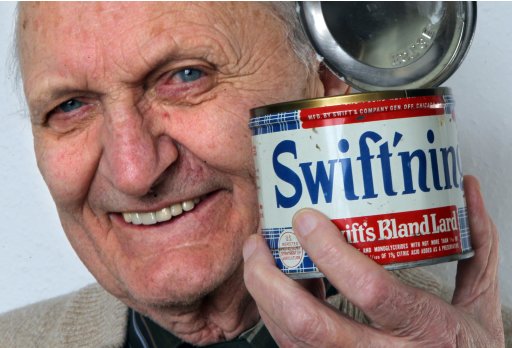
64-year-old tub of lard found in Germany -- still edible

http://l.yimg.com/bt/api/res/1.2/XI_H6FaOkzO1RVH.zM5IsQ--/YXBwaWQ9eW5ld3M7Zmk9aW5zZXQ7aD0zNDg7cT04NTt3PTUxMg--/http://media.zenfs.com/en_us/News/afp.com/TRDV1114947.jpg 
(AFP) A German pensioner who had kept a tub of lard in his cupboard for 64 years, took it to authorities who pronounced it very much fit for consumption -- if a little tasteless.

Retired chemist Hans Feldmeier, 87, told AFP he had received the pig fat as a student in 1948 near the northern city of Rostock as part of the post-war US aid programme.

Feldmeier said he had been given the tub together with two tins of noodles and some milk.

"I just didn't want to throw it away," he explained.

Finally, after 64 years, he took it to food safety agents and was astonished at their appraisal.

"There is of course a slight lack of smell and taste," sniffed Frerk Feldhusen, from the office of agriculture, food safety and fisheries in the eastern state of Mecklenburg-Western Pomerania.

Moreover, the lard was "of gritty consistency, difficult to dissolve and looked a bit old," the officials added.

However, "all in all, given its level of freshness and its material composition, the product is assessed as satisfactory," Feldhusen said, adding it would stand up to today's definition of being fit for the dinner table.

Wednesday, February 1, 2012

The lost pages of the Summa

Shared on a Yahoo group - Part of the Benedictine College philosophy department's celebration of St. Thomas' feastday included a contest: write your own question in the style of St. Thomas' Summa. The winning submission, written by Joseph R.

Whether a zombie possesses scientific knowledge?

Objection 1: It seems that a zombie cannot possess scientific knowledge. For the brain is required in order for the imagination to produce phantasms, and, as the Philosopher says in the De Anima, “the soul understands nothing without a phantasm.” Now it is known of zombies that they desire the human brain. But no thing desires what it already possesses, as was said above. Therefore zombies do not possess a brain and so cannot obtain the phantasms necessary for knowledge.

Objection 2: What does not have being cannot know. Now it is known that zombies can exist only during the “zombie apocalypse”, but nowhere in the Book of the Apocalypse does the apostle John mention zombies. Therefore zombies do not exist. Therefore they cannot know.


On the Contrary:

Although he only speaks one word, the word “brains”, it is known that a zombie is able to speak. But according to the Philosopher in De Interpretatione, “spoken words are the symbols of mental experience.” Therefore zombies have mental experience. In order to have mental experience one must have an intellect and be able to know. Therefore zombies must have scientific knowledge.


Response:

The term “zombie” is understood in two ways.

First, we call a man who is not acting in full rationality on account of drunkenness, sleeplessness, or laziness a zombie. Those who lack the necessary means to make themselves alert upon waking up are also called zombies. It is in this way that the Philosopher speaks of the Pythagoreans and those who proposed Ideas. While those spoken of as zombies in this manner may not act as if they possess knowledge, we must still say that they have both the capacity to know and the habit of scientific knowledge. For we would not say that a drunken man does not know, but only that he acts as if he does not know. In the same way, we would not say that the zombie, whether he is a lazy student or an exhausted man, does not know, but only that he does not act as if he does.

Secondly, we speak of a zombie as the nonliving corpse of a man made to move as if it were living. It is the opinion of some that a zombie of this kind is a dead body given some of the perfections of an animal soul while still remaining a dead body, but this is not possible. For the matter of a dead body, being without life, inasmuch as it is dead, has none of the perfections of a living being and cannot obtain these perfections unless it is in some way disposed to the reception of an animal soul. Therefore a zombie of this kind must be made to move as if it were alive by some exterior living agent, as the puppet though not alive, is made to move as if it were alive by the hand, which is living. But since there is no sign of an exterior material agent moving the corpse, as there is in the case of the puppet, we must say that the exterior agent moving the corpse is immaterial. But if this agent is immaterial, it must be capable of knowledge, as we said above. Therefore even this kind of zombie is capable of knowledge, or at least the agent moving the corpse.


Ad 1: A thing can be desired in two ways. First, according to its proper function. Second, because of some accident. It is in the second way that a zombie desires the human brain. For a zombie desires the brain not on account of its usefulness in producing phantasms, but according to an accidental aspect, namely, insofar as it is food for the zombie.

Ad 2: While there is no mention of a “zombie apocalypse” in the Book of Revelation, it is manifest that zombies can exist at times other than the last days. That zombies exist even at this time is clear from the writings of Siger of Brabant on the eternity of the world and the teachings of David of Dinant on the Divine Essence.

Thursday, January 19, 2012

Walken on the Wild Things

Read with such insight.


"...bear strung up, I assume murdered. Maybe suicide, I don't know."

Wednesday, January 4, 2012

Pepsi Says Mountain Dew Can Dissolve Mouse Carcasses

Jasper Nance via Flickr

(The Atlantic Wire) Pepsi Co., facing a lawsuit from a man who claims to have found a mouse in his Mountain Dew can, has an especially creative, if disgusting, defense: their soda would have dissolved a dead mouse before the man could have found it. An Illinois man sued Pepsi in 2009 after he claims he "spat out the soda to reveal a dead mouse," the Madison County Record reports. He claims he sent the mouse to Pepsi, which then "destroyed" the remains after he allowed them to test it, according to his complaint. Most shudder-worthy, however, is that Pepsi's lawyers also found experts to testify, based on the state of the remains sent to them, that "the mouse would have dissolved in the soda had it been in the can from the time of its bottling until the day the plaintiff drank it," according to the Record. (It would have become a "jelly-like substance," according to Pepsi, adds LegalNewsline.) This seems like a winning-the-battle-while-surrendering-the-war kind of strategy that hinges on the argument that Pepsi's product is essentially a can of bright green/yellow battery acid. The lawyers still appear to be lawyering behind the scenes but we cannot wait for this to come to trial (though we think a trial is about as likely as the chances of us "Doing the Dew" ever again).

Sunday, January 1, 2012

Facing Cocoa Shortage, Swiss Chocolate Makers Aim To Boost African Production

Famous for its chocolate production, Switzerland relies on Ghana for half its supply of cocoa beans, even as the West African nation now focuses on other export products. A new public-private Swiss partnership aims to inject new life into cocoa bean farming.


By Kaspar Meuli
LE TEMPS/Worldcrunch

SUHUM – It was one year ago that Ghana’s president John Atta Mills announced the country's first-ever launch of an oil platform. The December 15, 2010 pomp-filled ceremony, in front of television cameras, marked Ghana's arrival among the ranks of oil producers. Experts say that was also a bad day for the country’s cacao producers, as the raw material -- a traditional Ghanaian export -- would no longer get the attention or investment necessary to be sustainable.

The situation was particularly disquieting to Swiss chocolate makers as Ghana is their most important supplier. More than half of the cacao beans transformed into chocolate in Switzerland come from the Western African nation. “Cacao consumption goes up globally by 2% to 3% annually, and that rhythm has been sustained even during crisis periods,” says Kamillo Kitzmantel, General Manager of Lindt & Sprüngli Suisse. “Supply can’t meet demand, as new suppliers like Vietnam or the Philippines have yet to show that they can deliver the required quality levels.”

The Ghana Cocoa Board, a state-run organization that promotes cacao bean production, says that local trees have become too old, threatening to make harvests even more meager. If the 2011 harvest set a record it was only because of exceptionally favorable weather. And beyond the neglect of tree renewal initiatives, there is also a looming shortage of farmers. The average age of cacao farmers is around 55 years old – in a country where life expectancy is 58.

The face of such threats to its top supplier, Switzerland has stepped in with a private pilot project that is receiving Swiss government support. “We show farmers how they can earn money by growing cacao,” Yayra Glover explains. “The first step is to get the farmers to feel proud of their production. In Switzerland, there are buyers ready to pay above market price if cacao is produced without child labor or the use of chemical products.”

The Ghanaian entrepreneur lived in Switzerland for more than 20 years, then decided to return to Ghana to take up sustainable cacao farming. He is now located in Suhum, in the eastern part of the country, working with 2,500 small farmers who grow cacao organically.

Distribution chains and chocolate

Glover’s initiative was possible thanks to his close partnership with Pakka, a Zurich-based company specialized in the development of fair trade for organic produce from southern countries. Pakka also sells products like nuts, dried fruit – and cacao.

“Producers in southern countries can’t get into the European market on their own,” says Balz Strasser, Pakka’s general manager. “We support them by building the necessary networks and distribution chains.”

Part of the organic cacao from Ghana is thus delivered to Max Felchlin AG, a company in the canton (district) of Schwyz that provides chocolate makers and restaurants with semi-finished chocolate products.

A little more than four years on, the project has cost 1.3 million Swiss francs ($1.38 million). Nearly half (47%) came from the Swiss State Secretariat for Economic Affairs (SECO). The private sector (notably Pakka and Max Felchlin AG) and non-governmental organizations in Ghana came up with the rest.

The example of Yayra Glover may inspire others. The Economic Cooperation and Development division of SECO foresees geographic expansion into the Volta region in the southeast. This would also be a way of stemming rural exodus. Several of Glover’s young employees come from Accra, where they graduated from university. Today, they are dedicated to farming cacao. “I’ve bought some land of my own, and have put in some baby plants,” says Samuel Quaque, a manager at Glover’s company. “I imagine my future on a plantation, not in a city.”

Read the original article in French

Photo – Benketaro

Monkey stolen from California zoo found safe

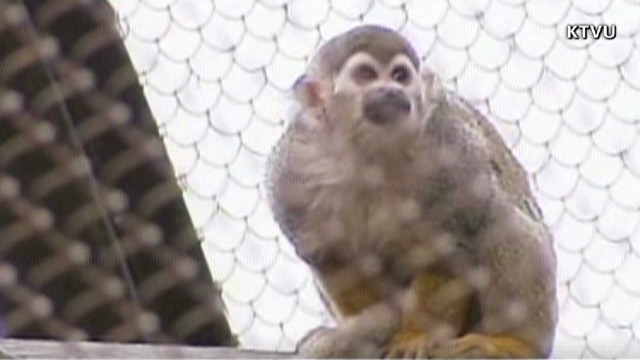
Banana-Sam, who was stolen from the San Francisco Zoo, was found Saturday safe, but hungry, officials said.

(CNN) -- Banana-Sam, a much-loved squirrel-monkey stolen from his enclosure at the San Francisco Zoo, has been safely returned, officials said.

The monkey was found Saturday night -- a day after he disappeared from the zoo -- at a park by a passer-by who spotted the primate in the bushes, the San Francisco Police Department said in a statement.

The passer-by coaxed the monkey from the bushes into his backpack, and then called the authorities, according to the statement.

Police officers brought the monkey to the zoo, where officials determined it was the missing primate.

"Although hungry, trembling and thirsty, Banana-Sam is currently safe back," the zoo said in a statement.

Zoo workers discovered the theft Friday morning, when they found a back perimeter gate had been breached and two holes cut in the mesh fence of the squirrel monkey exhibit.

The male monkey, known as Banana-Sam to his keepers, is age 17, over 12 inches tall and weighs about 2 lbs. Corrine MacDonald, the curator of primates and carnivores, told CNN affiliate KGO earlier Saturday that squirrel monkeys can live into their 20s, saying his relatively advanced age could put him at more risk.

Banana Sam' keepers warned the public that while he looks very cute, he is not a pet -- and can deliver a nasty nip. The curator said such monkeys carry diseases and can cause serious infections if they bite a human.

The monkey needs a specialized diet to stay healthy, the zoo says.

What motivated the thieves to swipe the monkey is not clear. Common squirrel monkeys are not endangered, and they can be found at pet trade markets -- with such sales illegal in California, the zoo says -- or medical research institutions.

MacDonald said the zoo's other squirrel monkeys were visibly shaken by Banana-Sam's apparent capture. She said the decision was made to pull them off the exhibit due to concerns about the integrity of the exhibit and that a "copy-cat" could try to take other monkeys.

It was not immediately known when the zoo planned to reopen the exhibit.

An unknown person was quick to set up a fake Twitter account in Banana-Sam's name, following in the path of a cobra that escaped at New York's Bronx Zoo in March. The snake's mock Twitter account, with humorous tweets on its supposed whereabouts in New York City, swiftly attracted a large online following.

Under the handle @SF_BananaSam, the "monkey" is now tweeting his way round San Francisco.

"Went to monkey bars in Golden Gate Park playground, left disappointed. #nobananadaiquiri" one post reads.

Another says: "I'm a funny-looking vegan who ran away from home and who people follow on Twitter. IN other words, A NORMAL SAN FRANCISCAN."